LESCO Bill Taxes Explained – What Are You Really Paying For?

You might be doing everything right from using energy-efficient appliances to even watching your LESCO peak hours, yet the total of your LESCO bill still surprises you. If this is the case, you’re not alone. Many LESCO customers feel confused when their bill jumps suddenly from one month to another.
The truth is, your total bill isn’t just about how many units you consume. A big part of it comes from taxes, surcharges, and government adjustments that most people don’t fully understand.
In this guide, we’ll clearly explain every LESCO bill, tax, and extra charge, from FPA and GST to Income Tax, TV Fee, and QTR Adjustment, so you’ll finally know what you’re really paying for each month.
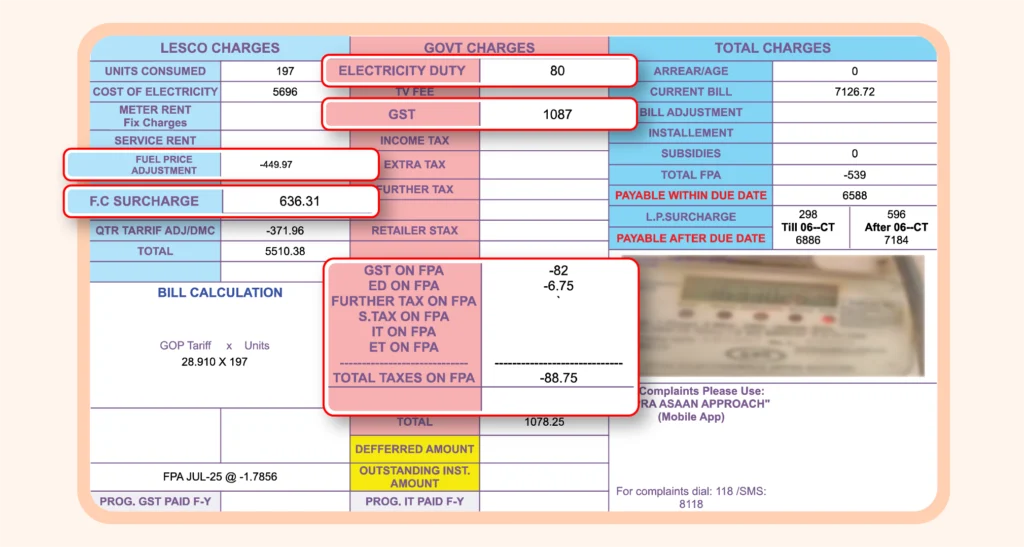
1. General Sales Tax (GST)
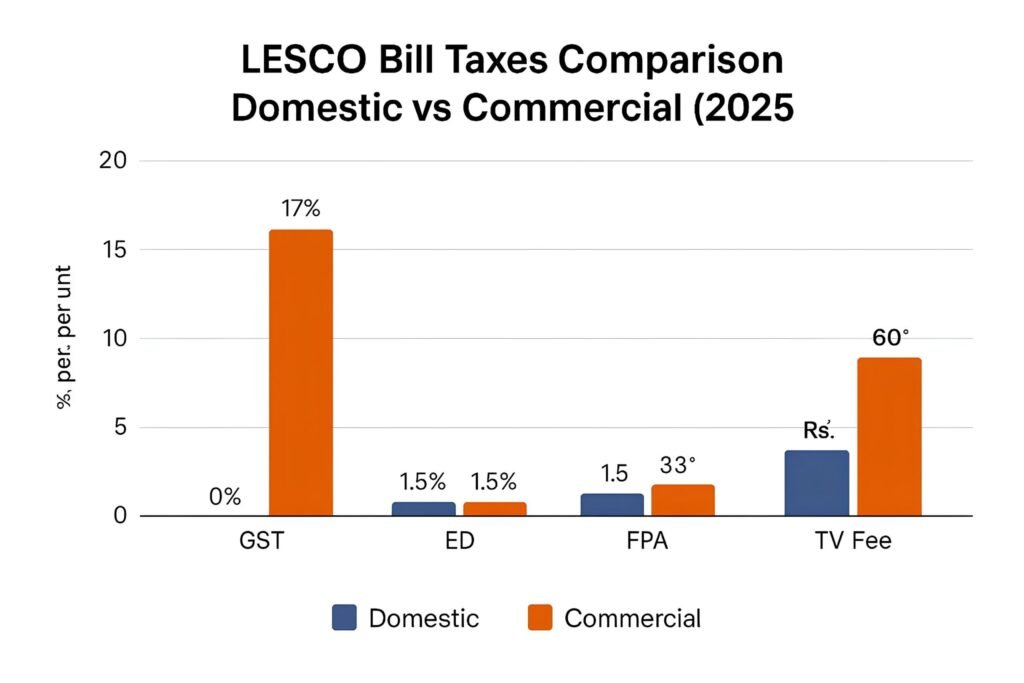
General Sales Tax (GST) is a government tax added to your LESCO electricity bill.
It is charged at 17% of the total electricity cost and collected by the Federal Board of Revenue (FBR).
GST mainly applies to commercial, industrial, and high-usage domestic consumers. Smaller households that use less than 300 units per month usually don’t have to pay this tax.
| User Type | Is GST Applied? |
| Domestic (below 300 units) | Usually not |
| Domestic (above 300 units) | Yes |
| Commercial / Industrial | Yes |
In simple words, GST is added as a percentage of your total bill amount. The amount collected goes to the government, not LESCO, and helps fund national projects, infrastructure, and energy development.
2. Income Tax (Withholding Tax) on LESCO Bill
Income Tax, also called Withholding Tax, is deducted from your LESCO electricity bill if you are a non-filer, meaning you haven’t registered your income with the Federal Board of Revenue (FBR).
The tax amount varies depending on your monthly electricity consumption. If you are a filer, you usually pay a much lower tax or none at all.
| User Type | Tax Deducted? |
| Filer | No (or very low) |
| Non-filer | Yes |
| Commercial / Industrial | Yes |
LESCO deducts this tax on behalf of the FBR, not for its own profit. It’s a government rule meant to encourage people to become tax filers and contribute to the national economy.
3. Electricity Duty (ED) on LESCO Bill
Electricity Duty (ED) is a small tax charged by the Punjab Government on your LESCO electricity bill. For most domestic consumers, this is approximately 1.5% of the total bill amount.
LESCO does not keep this tax. It’s collected on behalf of the provincial government.
The money from ED is used to support local infrastructure, energy projects, and public services within Punjab.
In short, the more electricity you use, the slightly higher your ED charge will be — since it’s calculated as a percentage of your bill.
4. TV License Fee on LESCO Bill
The TV License Fee is a fixed amount added to your LESCO electricity bill every month. For domestic users, it’s Rs. 35, and for commercial users, it’s Rs. 60.
This fee doesn’t go to LESCO. It goes directly to the Pakistan Television Corporation (PTV). It’s meant to help fund national broadcasting services and maintain public television operations across Pakistan.
Even if you don’t watch PTV channels, this charge still appears on your bill as part of the standard government fee.
5. Neelum–Jhelum Surcharge on LESCO Bill
The Neelum–Jhelum Surcharge is a small charge of Rs. 0.10 per unit added to your LESCO bill.
It was first introduced to help fund the Neelum–Jhelum Hydropower Project, one of Pakistan’s major energy initiatives aimed at increasing electricity production through hydropower.
Although the project is now operational, this surcharge remains active on most electricity bills. The collected amount helps with loan repayments, project maintenance, and power sector development.
6. Financing Cost (FC) Surcharge on LESCO Bill
The Financing Cost (FC) Surcharge is an additional charge of Rs. 0.43 per unit on your LESCO electricity bill. The government collects this surcharge to help repay loans and manage the circular debt within Pakistan’s power sector.
In simple terms, it’s a way for the government to recover the costs of producing and supplying electricity across the country. Although it may seem small, this charge adds up over time, especially for high electricity users.
7. Fuel Price Adjustment (FPA) on LESCO Bill
The Fuel Price Adjustment (FPA) is one of the most changeable charges on your LESCO electricity bill. It reflects the difference in fuel prices used for power generation during the previous months.
If fuel prices go up, the FPA becomes positive, meaning you’ll see an extra charge on your bill. But if fuel prices drop, it can turn negative, giving you a small rebate or relief on your next bill.
In short, FPA helps balance the cost between what LESCO paid for fuel earlier and what you’re charged now — making it one of the most unpredictable parts of your bill.
8. Quarterly Tariff Adjustment (QTR Adj.) on LESCO Bill
The Quarterly Tariff Adjustment (QTR Adj.) is reviewed and applied every three months by NEPRA (National Electric Power Regulatory Authority).
It’s based on changes in electricity generation, transmission, and distribution costs over the past quarter.
Depending on NEPRA’s review, your bill amount may increase or decrease. If the overall power supply cost went up, you’ll see a small extra charge, and if it went down, you might get a slight reduction in your bill.
9. Deferred Amount (if any)
Sometimes, you’ll notice a Deferred Amount mentioned on your LESCO bill.
This is an optional payment that you can postpone to the next month without paying any late surcharge or penalty.
It’s usually offered to help consumers manage temporary financial strain or unexpectedly high bills.
If you choose to defer it, the amount will simply be added to your next month’s bill.
Why Do These Taxes Exist on LESCO Bills?
Why are there so many different taxes and surcharges on your LESCO electricity bill? These charges are not random. They exist for specific reasons that help the government and power sector function smoothly.
Here’s why these taxes are added:
- To maintain and upgrade energy infrastructure, like power plants and transmission lines.
- To fund public services, including the Pakistan Television (PTV) network.
- To adjust for inflation and fuel price changes, primarily when Pakistan imports costly energy resources.
It’s essential to note that LESCO doesn’t retain these taxes. They are collected on behalf of government authorities such as NEPRA, FBR, and the provincial energy departments.
How to Calculate the Tax Portion in Your LESCO Bill
If you’ve ever wanted to know how much of your bill goes into taxes and surcharges, here’s a simple way to calculate it:
- Look at your total bill amount.
- Subtract the “Cost of Electricity” (units consumed × per-unit rate).
- The remaining amount is what you’re paying in taxes, fees, and surcharges.
Pro Tip: You can even compare this month’s bill with a previous one to see how taxes have changed over time.
Also calculate your LESCO bill online to estimate your bill and plan prior.
How to Verify Tax Rates (Official Sources)
If you want to double-check tax rates or confirm current charges, always refer to official government sources:
- NEPRA Tariff Notifications – For tariff adjustments, FPA, and quarterly revisions.
- FBR Withholding Tax Schedules – For income tax and GST rates.
Checking these official websites helps ensure you’re always viewing accurate and up-to-date tax information.
Conclusion
Your electricity bill from LESCO is significantly higher than the amount of electricity you actually used. The bill also includes several taxes, costs, surcharges, and adjustments imposed by various government bodies.
Once you understand these charges, you can start taking steps to lower your total electricity cost by following some practical ways to reduce your LESCO electricity bill.
Tracking this information will help you spot errors or any costs imposed on you that should not be there, so that the next time you receive your bill, you will know exactly where your money is going.