The Complete Off-Grid Solar Inverter Guide: Benefits, Pricing, and Buying Tips for 2026

Solar energy is changing how we run our homes and businesses fast, yet an off-grid solar inverter makes it actually work. While more people shift toward greener options, producing your own power rather than relying on the main grid matters way more now.
Imagine a system running by itself, no power bills, no surges, no blackouts, yet still fully powered. This setup relies on a combination of solar panels, inverters, and sometimes batteries, similar to how rooftop solar power systems generate electricity for homes and businesses, converting sunlight into usable AC power for appliances.
In this blog, we’re breaking down all things about off-grid solar inverters, what they do, why they help, what kinds exist, cost ranges, and how to pick the right fit for your setup. Let’s explore together!
What is an Off-Grid Solar Inverter?
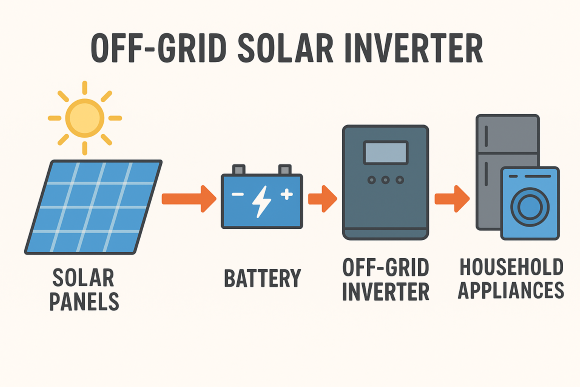
An off-grid solar inverter is a standalone power device that turns solar energy and battery power into usable electricity for your home.
It turns the DC power stored in batteries into AC electricity that your home appliances can use. Unlike on-grid or hybrid inverters, it operates 100% independently from the utility grid.
It gives you reliable, self-sufficient energy whether you’re powering a remote cabin, a rural home, an RV, a farm, or simply preparing your house for emergencies during a power cut.
Types of Off-Grid Solar Inverters
There are two main types of off-grid inverters mentioned below:
1. Pure Sine Wave Off-Grid Inverter
A pure sine wave off-grid inverter delivers power that flows just like what comes from regular electric lines, smooth and steady. So it’s ideal for houses, particularly if you’re using sensitive or expensive electronics.
Best for:
- Refrigerators
- Air conditioners
- TV and computers
- Medical devices
- Modern appliances with motors or microprocessors
Why is it better
- Runs appliances quietly
- Prevents overheating and long-term damage
- Supports heavy-load and sensitive electronics
- Delivers stable voltage without fluctuations
If you want a reliable off-grid setup for your home, a pure sine wave inverter is the gold standard.
2. Modified Sine Wave Inverter
A modified sine wave inverter gives a basic working signal, though less steady or effective compared to pure sine models, using rougher steps instead of smooth curves, so devices might hum slightly louder while running.
Best for:
- Low-power off-grid needs
- Small appliances without sensitive components
- Lights
- Simple electronics
Pros
- Much more affordable
- Works fine for low demand, simple setups
- Suitable for occasional or emergency use
Cons
- Can cause buzzing or humming noises
- May reduce the lifespan of appliances
- Not ideal for sensitive electronics
- Less energy efficient
Features of an Off-grid Inverter
A modern off-grid inverter includes several features that boost performance, safety, and user experience:
- Multiple battery voltage options (12V / 24V / 48V)
- High surge capacity for starting motors and compressors
- Integrated solar charging mode (in inverter/charger models)
- LCD or digital monitoring displays
- Wi-Fi / Bluetooth smart app controls
- Advanced safety protections: overload, overheat, short-circuit, and low battery protection
Benefits of an Off-Grid Solar Inverter
Living without grid power using solar panels brings several perks people like. A few advantages include: while saving money on bills, cutting carbon emissions, and gaining energy independence, no more blackout worries either.
- Energy independence means running your place off-grid. So you’re not stuck depending on power companies.
- Steady backup power: runs key devices during blackouts or when the supply is cut.
- Lower Long-Term Costs: reduces your monthly electricity bills over time.
- Eco-friendly: runs on solar power, so it cuts down pollution.
- Perfect for far places: gives steady power when lines are spotty or missing.
- Handles new battery types: runs smoothly on lithium or lead-acid ones.
- Flexible setup: grows with your needs – add panels or swap in more batteries when required.
- Runs super quiet – unlike noisy fuel generators – for a calmer time away from the grid.
Off-Grid vs On-Grid vs Hybrid Inverter: Key Differences
| Feature | Off-Grid Inverter | On-Grid Inverter | Hybrid Inverter |
| Power Source | Batteries + Solar | Grid + Solar | Grid + Solar + Batteries |
| Works Without Grid? | Yes | No | Yes |
| Backup Power | Excellent | None | Excellent |
| Cost | Medium | Low | High |
| Best For | Remote, unstable grid | Homes with a stable grid | Mixed-grid reliability |
How to Choose the Best Off-Grid Inverter
Picking a good off-grid solar inverter matters a lot if you’re setting up solar power. A solid choice keeps things running smoothly, prevents your devices from damage, and gets the most out of what you’ve spent on panels. This straightforward guide provides clear steps to help you find the best fit without confusion.
1. Determine Your Power Load Requirement
Begin by figuring out how much electricity your house uses. You can calculate your electricity bill to determine the running and surge watts for each gadget.
- Running (continuous) watts
- Surge (starting) watts
Heavy appliances like refrigerators, water pumps, and ACs require higher surge power.
Example (Small Home Load Estimate):
- LED lights: 100–200W
- Fans: 150–300W
- Refrigerator: 150–400W (with 1200W surge)
- TV: 80–150W
- Wi-Fi router: 10–20W
Tip: Go for an inverter that covers your full running power needs and an additional 20-30% safety margin.
2. Pick the Correct Battery Voltage (12V, 24V, 48V)
The battery voltage determines your system’s efficiency and scalability.
12V → For small cabins, RVs, and tiny homes (under 1.5kW system).
24V → Medium homes with moderate load (2–4kW system).
48V → Large homes or high-consumption systems (5–10kW+ system).
Higher-voltage systems reduce wire losses and improve efficiency, ideal for modern households.
3. Choose the Inverter Capacity (1 to 10 kW+)
Your inverter size relies on how much power you use each day. Small places or simple systems work well with a 1–3 kW inverter. A 3–5 kW inverter works well for homes running several devices at once, providing steady power without overload.
Big houses or totally off-grid setups might need 5–10 kW or more.
Tip: Got appliances like ACs, washers, or water pumps? Go for 5kW or more. When powering heavy appliances, a stronger system works better.
4. Select Pure Sine vs Modified Sine
A pure sine wave inverter is safe for all appliances and best for homes. It operates without making noises and is highly efficient. A modified sine wave inverter is cheaper but not safe for sensitive electronics and causes buzzing.
Recommendation: Always choose the pure sine wave off-grid inverter for long-term reliability and appliance protection.
5. Check Efficiency, Warranty, and Safety Protection
A solid off-grid inverter guards against overload, short circuits, heat issues, or draining the battery too much. While handling power surges well, it typically comes with a guarantee of one to three years.
6. Compatibility with Lithium/Lead-acid Batteries
Modern systems use lithium (LiFePO₄) batteries, which offer:
- 3x longer lifespan
- Faster charging
- Higher depth of discharge
- No maintenance required
Make sure your inverter supports lithium BMS protocols (many new inverters do).
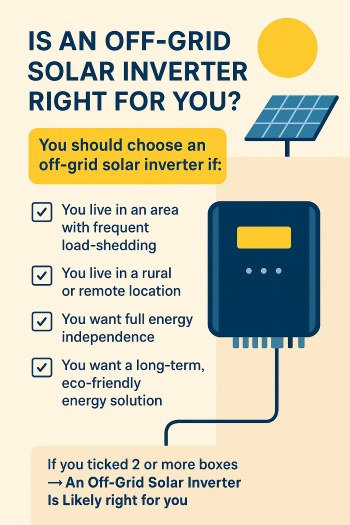
Quick Checklist: Is an Off-Grid Inverter Right for You?
Costs of an Off-Grid Solar Inverter (2026 Pricing Guide)
Below is the updated pricing landscape for 2026.
| Off-grid Inverter Type | Capacity | Price Range |
| Pure Sine Wave | 1-2 kW | Rs 35,000 – 75,000 |
| 3-5 kW | Rs 90,000 – 250,000 | |
| 6-8 kW | Rs 250,000 – 450,000 | |
| 10 kW+ | Rs 500,000 – 900,000 | |
| Modified Sine Wave | 1-3 kW | Rs 18,000 – 45,000 |
| 4-5 kW | Rs 50,000 – 70,000 |
Note: Off-grid inverter costs in Pakistan vary by size, manufacturer, and whether they include MPPT technology.
Long-term ROI Overview
- No monthly electricity bills
- Reduced generator fuel costs
- Minimal maintenance
- 10 to 15-year inverter lifespan
- 8 to 12-year battery lifespan (lithium)
- 25-year solar panel lifespan
Many homes get their money back in 3 to 6 years, depending on how much they use it.
FAQs
Can an off-grid inverter work without batteries?
No. It requires batteries to run your appliances.
Is it possible to power both an AC and a fridge using an off-grid inverter?
Yes, just make sure the inverter can handle sudden power spikes.
What is the difference between inverter wattage and surge wattage?
Inverter wattage is the normal running power, while surge wattage is the extra power needed to start motors.
Final Thoughts
A standalone solar inverter gives steady, self-made power, perfect if you’re far from cities or deal with constant blackouts. Once you know how much electricity you use, pick the correct model, and also look at prices, you’ll be nearly ready to decide. An off-grid solar inverter works best when you care about managing your own supply while cutting bills down the line. Check what’s out there, fit it to how you live, then go with whatever offers real energy independence and keeps things running smoothly.